Classroom Timesavers by Worksheet Place: Science of Reading

Showing posts with label Science of Reading. Show all posts

Over 50 FREE Reading Comprehension Passages for Your 1st Graders

Over 50 1st Grade Reading Passages

Why Grade 1 Students Should Use Reading Passages to Improve Reading, Fluency, and Comprehension:

Reading passages are a powerful tool for helping first grade students develop their reading skills, fluency, and comprehension. These passages provide young learners with opportunities to practice reading in a structured and engaging way, which is essential for their literacy development. Free here.

Benefits of Reading Passages
Reading passages help students practice reading words, sentences, and stories at an appropriate pace. This practice enhances their ability to read smoothly and accurately, which is crucial for overall reading fluency.

Enhanced Comprehension: By reading passages, students are exposed to a variety of texts that build their background knowledge and vocabulary. This exposure helps them understand the context and meaning of the text, leading to better comprehension skills.

Increased Engagement: These free reading passages include interesting and relatable content, such as stories about animals, adventures, and everyday activities. This engaging content motivates students to read more and enjoy the process of learning.

Development of Critical Thinking Skills: As students read passages, they learn to analyze and evaluate the information presented. This process helps them develop critical thinking skills, which are essential for academic success. EACH passage contains comprehension and higher level thinking questions.

Science of Reading
The Science of Reading is a research-based approach to teaching reading that emphasizes the importance of phonemic awareness, phonics, fluency, vocabulary, and comprehension. Reading passages align perfectly with this approach by providing students with opportunities to practice these key components in a cohesive and effective manner.

Phonemic Awareness and Phonics: Reading passages help students recognize and manipulate individual sounds in words, which is essential for phonemic awareness. They also provide practice in linking sounds to letters and decoding words, which is crucial for phonics development.

Fluency: As students read passages, they practice reading words, phrases, and sentences with appropriate speed and expression. This practice helps them develop reading fluency, which is a critical component of the Science of Reading.

Vocabulary: Reading passages expose students to new words and phrases, helping them expand their vocabulary. This exposure is vital for vocabulary development, which is another key component of the Science of Reading.

Comprehension: By reading passages, students practice understanding and interpreting the text, which enhances their comprehension skills. This practice is essential for developing strong comprehension abilities, as emphasized by the Science of Reading.

Using reading passages is an effective way to support 1st grade students in their reading, fluency, and comprehension development. These passages provide structured practice in key reading components and align with the principles of the Science of Reading, making them a valuable resource for young learners.

Beyond Long and Short Vowels

Understanding R-Controlled and L-Controlled Vowels in Phonics Instruction
Free Science of Reading Phonics Printables

All too often, parents, teachers and homeschools make the serious errors of classifying words into two categories of vowel sounds - long and short. This is wrong!

In the realm of phonics instruction, long and short vowels have long been considered foundational. However, limiting our understanding to just these two categories overlooks the complexities of vowel sounds in the English language. While long and short vowels play an important role, it's equally important to recognize and teach r-controlled and l-controlled vowels to ensure comprehensive literacy development in young learners.

R-controlled vowels, such as "ar," "er," "ir," "or," and "ur," have a unique sound quality due to the influence of the letter "r." For example, in words like "car," "her," "bird," "fork," and "turn," the vowel sounds are altered by the presence of the following "r." Similarly, l-controlled vowels, like "al," "el," "il," "ol," and "ul," produce distinct sounds influenced by the letter "l," as seen in words like "ball," "bell," "milk," "fold," and "pull."

Despite their significance, the inclusion of r-controlled and l-controlled vowels in phonics instruction is often overlooked or minimized in favor of a simplified focus on long and short vowels. This oversight can lead to gaps in students' phonemic awareness and decoding skills, hindering their reading proficiency.

For homeschoolers and educators alike, selecting phonics resources that encompass a broader spectrum of vowel sounds is essential for comprehensive literacy development. Look for curricula and teaching materials that explicitly address r-controlled and l-controlled vowels, providing ample opportunities for students to practice and master these sounds in context.

Interactive activities, such as word sorts, word hunts, and phonics games, can engage learners while reinforcing their understanding of r-controlled and l-controlled vowels. Incorporating multisensory approaches, like tactile letter manipulatives and auditory discrimination tasks, can further enhance students' phonics skills and overall reading fluency.

By broadening the approach to phonics instruction beyond long and short vowels to include r-controlled and l-controlled vowels, students will proficient readers who can navigate the complexities of the English language. Let's ensure that our phonics resources and teaching practices reflect the rich diversity of vowel sounds, equipping learners with the skills they need to succeed in reading and beyond.

At worksheetplace.com, you will find all the sounds including short and long. Free for your educational needs.

Short Vowel Sounds Unit - CVC Words for Kindergarten 1st Grades

All of these free activities are in google slides and printables.
Use these engaging and motivating short vowel activities,CVC (Consonant-Vowel-Consonant) worksheets and Google Slides designed for kindergarten and 1st-grade classes. Foster early literacy skills as students dive into a variety of fun activities, promoting phonemic awareness and mastery of essential reading foundations. These  interactive resources make learning short vowel sounds a breeze, creating a dynamic and educational experience for young learners."

Please note, the ads keep all of our resource free!! Suggestions are always welcome.

https://worksheetplace.com/index.php?function=DisplayCategory&showCategory=Y&links=4&id=872&link1=43&link2=266&link3=288&link4=872&cn=Short_Vowel_Sounds_Worksheets

Consonant Blends Hands On Activities for 1st and 2nd Graders FREE!

The science of reading emphasizes the importance of explicit and systematic phonics instruction, including the teaching of consonant blends, to support effective reading development. Consonant blends are two or more consonant letters that appear together in a word without any intervening vowels, such as "bl" in "blue" or "tr" in "tree."
For all 24 of these activites as shown above, they are free at my store!
  1. Systematic Phonics Instruction: Phonics instruction should be systematic, meaning that it follows a logical and planned sequence. Students should be introduced to consonant blends in a structured manner, starting with the most common blends and progressing to more complex ones.

  2. Explicit Instruction: Teachers should provide explicit instruction on how to blend consonant sounds together. This involves teaching students to smoothly combine the individual sounds represented by the consonant letters in a blend.

  3. Multi-Sensory Approaches: Incorporating multi-sensory approaches, such as using manipulatives, movement, and visual aids, can enhance the learning experience for students. This helps them connect the sounds of consonant blends with letters and symbols in a more comprehensive way.

  4. Word Decoding Practice: Students should have ample opportunities to practice decoding words containing consonant blends. This includes reading words in isolation, in sentences, and within connected texts. The goal is to develop automaticity in recognizing and decoding words with blends.

  5. Integration with Reading and Spelling: Phonics instruction should not be isolated from other aspects of reading and language instruction. Integrating the teaching of consonant blends with reading and spelling activities helps students apply their knowledge in real-world contexts.

  6. Assessment and Feedback: Ongoing assessment is crucial to monitor students' progress in mastering consonant blends. Teachers should provide timely and constructive feedback to address any challenges and reinforce positive learning experiences.

Free Digital and Printable 1st Grade Decodable Sentences

CVC words decodable sentences
Free Google Slides/Printables
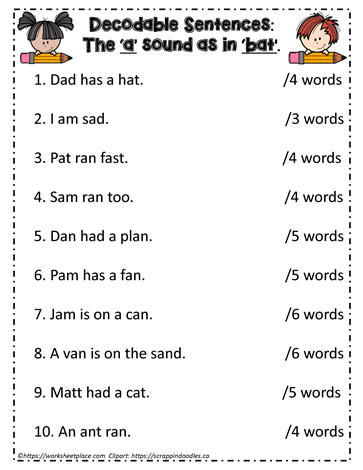
CVC decodable sentences are a fantastic tool to help 1st grade students learn to read. There are over 20 free digital and printable worksheets for students to decode each of the senences that focus on the short vowel sounds. Sentences like Dad has a hat. I am sad. Students take the time to read each sentence and identify how many of the words they could read. These Grade 1 Short Vowel Sentence Worksheets designed to boost early reading skills! Our carefully crafted worksheets focus on short vowel sounds, providing a fun and interactive way for students to master fundamental phonics principles. With a variety of activities, these worksheets help young learners recognize, read, and build short vowel-based sentences, laying a strong foundation for literacy. Enhance your Grade 1 classroom or homeschooling experience with our printable resources, promoting confidence and proficiency in decoding short vowel words.

The Benefits Of Having Students Unscramble Sentences:

Scrambled Sentences Worksheets and Activities
Free Printables Here

Unscrambling basic sentences offers several benefits for grade 1 students as they develop their language and literacy skills:

Vocabulary Development: Unscrambling sentences exposes students to a variety of words and helps them understand their meanings in context. This contributes to vocabulary expansion.

Sentence Structure: Students learn about the structure of sentences, including word order, subject-verb agreement, and punctuation. This knowledge is fundamental for their writing and reading skills.

Grammar Skills: Unscrambling sentences helps students recognize and use correct grammar, such as verb tenses, plurals, and articles, as they piece together sentences.

Reading Comprehension: This activity encourages students to think critically about the order and meaning of words, improving their understanding of texts and reading comprehension.

Phonics and Decoding: Unscrambling words and sentences reinforces phonics and decoding skills as students identify and sound out words.

Spelling and Letter Recognition: It enhances spelling skills and reinforces letter recognition as students work with individual words.

Critical Thinking: Unscrambling sentences requires students to think logically and sequentially, boosting their critical thinking skills.

Writing Skills: As students work on unscrambling sentences, they gain an understanding of how to construct their own sentences, which is beneficial for their writing abilities.

Sentence Fluency: Exposure to different sentence structures through unscrambling activities improves sentence fluency and diversity in their writing.

Problem-Solving: Unscrambling sentences is a type of problem-solving activity. It helps students develop problem-solving strategies and persevere in finding solutions.

Confidence Building: Successfully unscrambling sentences can boost students' confidence in their language and literacy skills.

Group Collaboration: These activities can be used for group work, fostering collaboration and communication skills.

Assessment: Teachers can use unscrambling activities as formative assessments to gauge students' grasp of language and sentence structure.

Differentiation: Educators can tailor unscrambling activities to suit the needs of individual students, making them simpler or more challenging as necessary.

Engagement and Fun: Unscrambling sentences can be a fun and interactive way to learn language skills, making the learning process enjoyable for young students.

In summary, unscrambling basic sentences is a valuable tool for building foundational language and literacy skills in grade 1 students. It engages them in a range of skills, from vocabulary development to reading comprehension and critical thinking, ultimately preparing them for more advanced language and literacy tasks.

Free Printables Here


Boost Reading Skills with Teaching Using the Science of Reading

.


The resources provide here are free and are based on The
Science of Reading, which is a comprehensive, evidence-based approach to teaching children how to read that emphasizes the importance of explicit, systematic instruction in the five essential components of reading: phonemic awareness, phonics, fluency, vocabulary, and comprehension. This approach to teaching and learning, known as evidence-based reading instruction, is based on research demonstrating that these five components are the most important elements of reading. Explicit instruction in these five components helps children learn to read quickly, efficiently, and effectively. Teachers make sure that students have access to high-quality and appropriate text to read and practice with. 1. Phonemic Awareness: Phonemic awareness is the ability to hear and manipulate individual sounds (phonemes) in spoken language. To teach children this skill, start by teaching them to identify the individual sounds (phonemes) in words. This can be done through activities such as rhyming, blending and segmenting words, and identifying beginning, middle, and ending sounds. 2. Phonics: Phonics is the understanding that letters represent the sounds of
language
. To teach children phonics, start by teaching them the letters of the alphabet and their corresponding sounds. Then, move on to teaching them how to blend sounds together to make words. 3. Fluency: Fluency is the ability to read words accurately and quickly. To teach children this skill, start by teaching them to read slowly and accurately. Then, gradually increase the speed at which they read. You can also use activities such as partner reading, choral reading, and repeated readings to help them become more fluent. 4. Vocabulary: Vocabulary is the understanding of words and their meanings. To teach children vocabulary, start by teaching them common sight words and increasing their exposure to new words through reading and conversations. You can also teach them the meanings of words through the use of context clues and direct instruction. 5. Comprehension: Comprehension is the ability to understand what is being read. To teach children this skill, start by teaching them how to identify the main idea and supporting details in a text. Then, move on to teaching them how to make inferences, draw conclusions, and identify cause and effect relationships.